
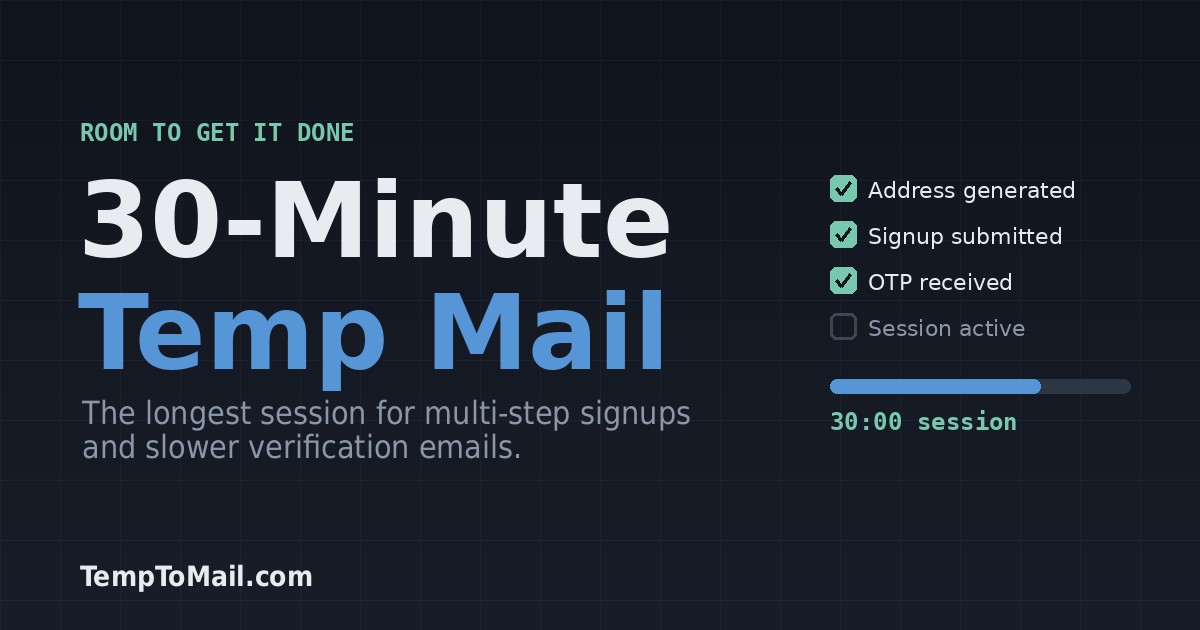
Complete Guide to 30 Minute Mail: Comprehensive Temporary Email Service
In today's complex digital landscape, email verification processes have become increasingly sophisticated. Modern services often require multiple confirmation steps, document uploads, and identity verification that extend beyond traditional short-duration disposable emails. The 30 minute mail service addresses this growing need by offering a disposable email address that automatically expires after 1800 seconds, providing comprehensive time for complete verification processes.
Whether you're setting up a detailed account, going through multi-step verification, receiving multiple confirmation emails, or completing lengthy registration forms, the 30-minute temporary email service ensures you have sufficient time without compromising your privacy. Unlike permanent email addresses that become spam magnets, disposable emails vanish along with all associated messages, leaving no digital footprint for marketers or data brokers to exploit.
What Makes 30 Minute Mail the Comprehensive Choice?
The 30-minute duration offers comprehensive time for complex verification processes while maintaining the disposable nature of the service. Common use cases include:
- Multi-Step Account Creation: Modern platforms often require email verification, phone verification, identity confirmation, and profile setup. A 30-minute email provides sufficient time for the entire process.
- Document Verification: Many services require document uploads and verification that may take several minutes to process. Use a 30-minute email to complete the full cycle.
- Professional Certification: Online certification and professional platforms require detailed registration with multiple confirmation steps. The 30-minute window accommodates the complete process.
- Financial Services: Banking and financial platforms often require extensive verification processes. Use a 30-minute email for secure account creation.
- Healthcare Portals: Medical and healthcare platforms require comprehensive registration with multiple verification steps. The extended duration ensures completion.
How Our 30-Minute Email System Works
The technical architecture behind our 30-minute mail service combines advanced technologies to deliver a seamless and secure experience:
- Instant Address Generation: When you load the page, our system creates a unique email address using a combination of random characters and our domain. This process takes less than a second.
- Real-Time Email Reception: Our mail servers accept incoming messages for any address at our domain. When an email arrives, it's instantly parsed and stored in a temporary cache.
- Automatic Polling: Your browser checks for new messages every 4 seconds, ensuring you see incoming emails almost immediately after they're sent.
- Intelligent OTP Detection: Our parsing engine scans email content for numeric verification codes, displaying them prominently for easy copying.
- Auto-Destruction: When the 30-minute timer expires, all messages are permanently deleted from our servers, and a new address is generated on page reload.
Privacy Benefits of Using 30-Minute Disposable Email
Privacy advocates and security experts consistently recommend using temporary email addresses for non-critical online activities. Here's why the 30-minute mail service enhances your digital privacy:
- Zero Data Retention Policy: We don't store any logs, metadata, or content from your temporary email sessions. Once the timer expires, everything disappears forever.
- Complete Anonymity: The service requires no name, phone number, or credit card details. You remain completely anonymous throughout your session.
- Prevents Email Tracking: Marketers often embed tracking pixels in emails to monitor open rates and user behavior. With disposable addresses, these tracking mechanisms become ineffective.
- Reduces Spam Volume: By using temporary addresses for trials and registrations, you prevent your primary inbox from being flooded with promotional content.
- Protects Against Data Breaches: If a service you've signed up for experiences a data breach, your temporary email is already expired, protecting your primary address.
Technical Specifications and Security
Our infrastructure is built on secure, enterprise-grade servers with multiple layers of protection:
- Encrypted Connections: All communications between your browser and our servers use TLS encryption (HTTPS), ensuring your data remains private.
- Memory-Only Storage: Incoming emails are stored in server memory rather than on disk, ensuring complete destruction when sessions end.
- Intelligent Rate Limiting: To prevent abuse, we implement intelligent rate limiting that blocks spam and ensures fair usage for all users.
- Content Security Scanning: All incoming messages are scanned for malicious content before being rendered in your browser.
- Regular Security Audits: Our systems undergo regular security audits to identify and address potential vulnerabilities.
Best Practices for Using 30-Minute Temporary Email
To maximize the effectiveness of your 30-minute mail experience, follow these recommended practices:
- Prepare Before Generating: Have the website or service ready to send your verification email before creating your temporary address.
- Copy Address Immediately: Use the copy button to save your email address to your clipboard for quick pasting into registration forms.
- Monitor the Timer: Keep an eye on the countdown timer. If you need more time, use the Extend Time button to reset it to 30 minutes.
- Check OTP Extraction: If you're expecting a verification code, check the OTP container in the email preview for automatic extraction.
- Clear Session When Done: Use the Delete Session button if you want to manually generate a new address before the timer expires.
Why 30 Minutes is the Comprehensive Duration
Our extensive user research has shown that 30 minutes provides the ideal comprehensive duration for complex verification scenarios. Here's why:
- Maximum Time: 30 minutes provides enough time to navigate through complex registration forms, receive multiple confirmation emails, and complete verification without feeling rushed.
- Security: The duration is long enough for comprehensive processes while still maintaining the disposable nature of the service.
- Convenience: Most verification emails arrive within 30-60 seconds, leaving plenty of time for the entire process.
- Flexibility: If you need more time, you can always extend the timer without losing your current email address.
- Comprehensive: The 30-minute window accommodates the most complex registration processes with multiple confirmation steps.
For services that require extensive verification processes, document uploads, or multiple confirmation steps, the 30-minute window provides a comfortable buffer while maintaining security. If you find yourself needing more time regularly, consider using our 50-minute duration option available in the navigation menu.
Common Use Cases for 30-Minute Mail
- Professional Certifications: Register for online certifications and professional development courses with complete verification.
- Financial Account Creation: Set up banking and financial accounts that require multiple verification steps.
- Healthcare Portals: Create accounts on healthcare platforms with comprehensive registration requirements.
- Educational Institutions: Register for online learning platforms and educational portals with detailed verification.
- Government Services: Access government portals and services that require email verification.
- Professional Networks: Create comprehensive professional profiles on networking platforms.
Why Choose TempToMail for Your Temporary Email Needs
TempToMail stands out among temporary email providers for several compelling reasons:
- Multiple Duration Options: We offer 3, 5, 10, 20, 30, and 50-minute options to suit different needs and scenarios.
- Clean, Ad-Light Experience: Unlike many free services, we maintain a clean interface focused on functionality without intrusive advertising.
- Reliable Infrastructure: Our servers are optimized for high availability and fast email delivery, ensuring you never miss important messages.
- Continuous Improvement: We regularly update our system to support new features and maintain the highest security standards.
- No Registration Required: Start using the service immediately without creating an account or providing personal information.
Recommended Privacy Resources
Enhance your online privacy with these trusted resources and tools:
- Learn about comprehensive temporary email solutions at Temp-Mail.org, a leading global temporary email service provider.
- Explore digital security best practices at Electronic Frontier Foundation, the premier digital rights organization.
- Check data breach exposure status for your main accounts on Have I Been Pwned, the industry standard for breach monitoring.
Frequently Asked Questions About 30 Minute Mail
What is a 30 minute temporary email address?
A 30 minute temporary email is a disposable email address that automatically expires after 1800 seconds. It's designed for comprehensive OTP verification and complete account registrations where you need extended time.
How does 30 minute mail protect my privacy?
The service generates a unique, anonymous email address that is not linked to your personal information. All messages are automatically deleted when the timer expires. We don't store logs or metadata of your sessions.
What happens when the 30-minute countdown ends?
When the timer reaches zero, the page automatically reloads and generates a new temporary email address. All previous messages are permanently purged from the system and cannot be recovered.
Can I extend the time if I need more than 30 minutes?
Yes, clicking the Extend Time button resets the timer back to 30 full minutes while keeping your current email address active. This gives you additional time to receive delayed messages.
Is registration required to use the 30 minute mail service?
No registration, credit card, or personal information is required. Simply visit the page and your temporary email is generated instantly. The service is completely free and anonymous.
Can I receive OTP codes with 30 minute mail?
Yes, our system automatically detects and extracts OTP verification codes from incoming emails. The codes are displayed prominently in the email preview for easy copying.
Are attachments supported in 30 minute temporary emails?
Yes, standard text and HTML content with confirmation links are rendered safely in our email viewer. Attachments are scanned for security before being displayed.
Is it safe to use 30 minute mail for sensitive accounts?
30 minute mail is ideal for non-critical registrations, trials, and OTP verification. For permanent accounts like banking or government services, always use your primary email address.
💡 Pro Tip: For the best experience with 30-minute mail, prepare all your registration steps before generating your temporary address. This ensures you can complete the entire verification process within the 1800-second window without rushing.